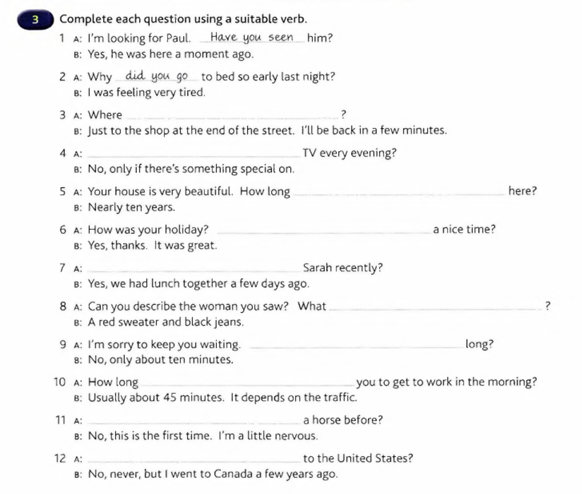
Today is the first class of our new January class period. The start time for our class will be 10:00am. We will begin class with a casual conversation. Our reading today is about favorite children. Please try to read as much as possible. Underline any words or sentences that are unfamiliar. Our listening is about Columbian horses. Please listen and read the transcript. We will complete our grammar sentences.
Click HERE for the reading
MILES PARKS, HOST:
Cartagena is one of Colombia's main tourist destinations, famous for its colorful streets and horse-drawn buggies. But officials in the city, which is a UNESCO World Heritage Site, want to retire the horses and replace those buggies with electric vehicles, citing concerns of animal welfare. Manuel Rueda has the story.
CRISTIAN MUNOZ: (Speaking Spanish).
MANUEL RUEDA, BYLINE: Cristian Munoz has been taking tourists around on his horse buggy for the past 20 years, showing them Cartagena's monuments and its narrow streets. But soon, his small horse cart will be outlawed by the city government.
MUNOZ: (Speaking Spanish).
RUEDA: "It's very sad," Munoz says. "We're part of this city's heritage, just like the walls that surround it." Cartagena sits on Colombia's Caribbean coast, and for hundreds of years, it was an important trading post for the Spanish empire. Its historic center is encircled by thick stone walls built by the Spaniards to fend off pirates. Inside, narrow streets wind past sun-drenched plazas and colonial mansions.
(SOUNDBITE OF HORSE HOOVES CLOPPING)
RUEDA: For decades, horse-drawn buggies have carried tourists through these streets, their large, spoked wheels clattering over the pavement.
SERGIO PUELLO: (Speaking Spanish).
RUEDA: "It's a nice way to get around 'cause it's hot here," says Sergio Puello, a tourist from Bogota.
UNIDENTIFIED PERSON: (Speaking Spanish).
RUEDA: But animal rights activists have long argued that these joyrides are terrible for the horses pulling the carriages. The weather in this Caribbean city is humid with temperatures that often exceed 90 degrees, and pulling carriages along cement roads can be stressful for the horses, says Fanny Pachon, a local activist.
FANNY PACHON: (Speaking Spanish).
RUEDA: "Horses are pack animals, and they're designed to carry things," she says. "But they're meant to be in rural areas, not in the middle of a city with paved roads."
PACHON: (Speaking Spanish).
RUEDA: "If you want to be a modern city, you have to protect the rights of animals, too," she says. After years of protests, the city is finally siding with animal rights activists. Starting December 29, traditional horse-drawn buggies will be banned and replaced by a fleet of 62 electric carriages imported from China.
(SOUNDBITE OF TOOL GRINDING)
RUEDA: In a warehouse outside the city, workers are assembling the new vehicles. They have big wheels and open tops, just like the traditional buggies, but they're powered by large batteries.
LILIANA RODRIGUEZ: We have to be a destination that cares about the people, that cares about the animals.
RUEDA: Liliana Rodriguez is the director of Cartagena's tourism promotion agency. She says the new carriages will be environmentally friendly because their batteries will be charged with solar power.
RODRIGUEZ: (Speaking Spanish).
RUEDA: "These are the kind of changes that new generations are demanding," she says. But the owners of Cartagena's horse carriages are worried. They say that the municipal government is pushing them out of a business they've spent decades building.
MIGUEL ANGEL BENITEZ: (Speaking Spanish).
RUEDA: Miguel Angel Benitez (ph) owns two horse carts that make around $150 per day.
BENITEZ: (Speaking Spanish).
RUEDA: "We're not against the transition." he says. "But we need to know how we'll be included."
(SOUNDBITE OF BIRDS CHIRPING)
RUEDA: Cartagena's mayor, Domek Turbay, says he has proposed compensation schemes to carriage owners that include giving them a share of the profits made by the city's new electric carts. He says he has been unable to make a deal with the cart owners, who are threatening to sue the city.
DOMEK TURBAY: (Speaking Spanish).
RUEDA: "I get the feeling that they're trying to take advantage of the situation," he says. Mayor Turbay says that tourists will be able to ride on the city's new electric carts for free for the next two months.
(SOUNDBITE OF HORSE HOOVES CLOPPING)
RUEDA: But others are wondering if tourists will want to ride on electric vehicles, even if they resemble 19th century carriages.
MUNOZ: (Speaking Spanish).
RUEDA: "People come to Cartagena for tradition," says cart driver Cristian Munoz. "Without the horses, it's not the same."
(SOUNDBITE OF HORSE HOOVES CLOPPING)
RUEDA: For NPR News, I'm Manuel Rueda in Cartagena, Colombia.