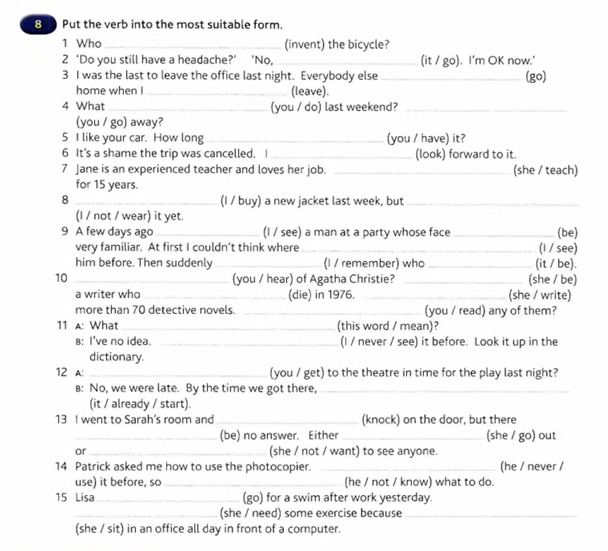
Today is the second class of our new February class period. The start time for our class will be 10:00am. We will begin class with a casual conversation. Our reading today is about taking about boyfriends. Please try to read as much as possible. Underline any words or sentences that are unfamiliar. Our listening is about extroverts and introverts. Pease listen and read the transcript. We will complete our grammar sentences.
Click HERE for the reading
MARIELLE SEGARRA, HOST:
You're listening to LIFE KIT...
(SOUNDBITE OF MUSIC)
SEGARRA: ...From NPR.
(SOUNDBITE OF MUSIC)
SEGARRA: Hey. It's Marielle. Reporter Yowei Shaw is an introvert who loves her extroverted friends. She wants to make that clear. There's just one problem - sometimes the energy is off.
YOWEI SHAW: The other week, I was hanging out with an extroverted friend, who I love dearly, and I felt pressured to match their energy, which I obviously didn't succeed at. And after the hang, I was like, what just happened? Why does hanging out with this person I love feel so bad? I bet it wasn't fun for them.
(SOUNDBITE OF MUSIC)
SEGARRA: While there isn't one agreed-upon definition, generally, extroverts tend to be more talkative, outgoing, energetic and really into socializing. And introverts tend to be more introspective, quiet, deliberate and really into alone time. But this is a spectrum, not a binary, and many of us fall somewhere in between the two. The thing is, there're a lot of people along this continuum who just don't quite get each other.
SHAW: And it's, like, really awkward to talk about because it feels like you're saying, essentially, I love you, but I'm having a hard time with your personality. Like, that's a harsh thing to say to a friend.
SEGARRA: Yowei is the host of the podcast "Proxy," where she uses her reporting skills to investigate exactly these kinds of emotional conundrums. On "Proxy," she connects people with a proxy - a stranger with relevant experience with their issue and none of the personal baggage. On this episode of LIFE KIT, Yowei talks out her issues with a proxy - an extreme extrovert who calls herself an introvert ally and has made it part of her life's work to help introverts and extroverts create strong partnerships at work. You'll hear about the common complaints each camp has about the other and get practical advice on how to have a better time and be better friends with people on the other side of the spectrum.
(SOUNDBITE OF MUSIC)
SHAW: Jennifer Kahnweiler has her doctorate in counseling and organizational behavior, but she decided to specialize in helping introverts and extroverts for a personal reason at first. Back in the '70s, when she married her husband, Bill, she'd never heard of these terms. All she knew was that the qualities that had attracted her to her husband were now becoming a challenge.
JENNIFER KAHNWEILER: One time, we were coming home from a party, and I said, oh, we could be friends with these people, and what about that hike they were talking about? And, like, I got nothing. It was like crickets. And I'm looking over at him, and I'm saying, what's going on? So I just revved it up more, asked more questions.
SHAW: What was frustrating for him? Did he tell you?
KAHNWEILER: I don't think he knew what to make of the spinning plates, you know? In his mind, he thought I was talking about doing everything, and he would just shut down because he would reflect on my suggestions, and then I was also throwing something else out there. I mean, that's what extroverts do - we think through our talking, whereas introverts will internalize. And so he was getting, I think, very stressed out.
SHAW: A week later, Jennifer happened to take a personality assessment, where she learned about introverts and extroverts.
KAHNWEILER: I learned that I was an extrovert - no surprise. I grew up in a very extroverted family in New York, and I didn't know many introverts, actually, until I met Bill. So I - and it was just this shift of, like, oh, to not pack up and go, but (laughter) to try to understand each other.
SHAW: Jennifer went on to write four books, conduct research, and she spent 25 years coaching and training thousands of leaders, teams and organizations to help introverts thrive in an extroverted world and help the two sides get along better.
KAHNWEILER: Now, my husband, Bill, you know, he'll still hold up one of my four books and say, read the book...
SHAW: (Laughter).
KAHNWEILER: ...Because I have to keep reminding myself.
(LAUGHTER)
SHAW: Not holding up your own book.
(SOUNDBITE OF MUSIC)
SHAW: Now, if you're allergic to personality categories, I get it, which brings me to the first takeaway - understand what introvert and extrovert means so you can better understand yourself and others. But, like, don't be reductive about it.
KAHNWEILER: There're so many other factors. I always say pairs of glasses that you could look through, but it's not to pigeonhole. I go by the anecdotal experience I've had with - you know, working with thousands of people who - their eyes light up. I mean, that's what I can just say when people say there's some kind of an explanation for some of my characteristics, and I would say some.
SHAW: A quick history lesson - in the 1920s, the famous Swiss psychologist Carl Jung coined the terms introversion and extroversion to mean basic orientations of energy. So introversion meant energy directed towards the self, and extroversion meant energy directed towards other people. But it wasn't till the Myers-Briggs personality assessment that these concepts came into popular use in the '70s. Myers-Briggs has since been discredited for inconsistent results and its binary view that either you're an introvert or you're an extrovert. But their definition of introversion and extroversion still dominates - you know, the idea that introverts recharge alone; extroverts recharge with other people.
Today, personality scientists stick to measurable behaviors - like sociability, assertiveness, activity level, positive emotions - and they see introversion and extroversion as opposite ends of a spectrum. So introversion means preferring small groups and solitude, being more reserved, calm, deliberate, serious, while extroversion means seeking social contact, enjoying large groups, being more talkative, dominant, enthusiastic. And where you fall on the spectrum isn't static. Context matters, and you can change as you get older.
All's to say, yes, there are meaningful differences, hence the tension, which brings us to the second takeaway - resist the urge to judge. Because let's be honest, you've probably talked some smack about your introverted and extroverted friends, or at the very least been frustrated by them. I asked Jennifer to hit me with the most common complaints she hears from extroverts about us introverts.
KAHNWEILER: They're slow - just slow in their movements. They, like, pause, and they talk slowly.
SHAW: This is so funny to hear.
KAHNWEILER: Another thing is that they don't show a lot of facial expressions. You're not giving me anything. Give me some cues.
SHAW: I was surprised to learn that there is some research that backs all of this up, which I will be thinking about at a later date. For now, time to criticize the extroverts. Here's what introverts will say about extroverts.
KAHNWEILER: Too many words. Can't be alone. Hate silence. Poor listeners. Extroverts will interrupt them. And the extroverts will say, in my defense, I thought you were done with your thought.
SHAW: Right.
KAHNWEILER: If I'm talking the whole time, it's all about me.
(SOUNDBITE OF MUSIC)
SHAW: As cathartic as it was to hear other introverts share some of my complaints, Jennifer says assumptions about the meaning of a behavior are unfair because it might just be personality differences. For instance, for her book "The Genius Of Opposites," Jennifer interviewed 40 introvert and extrovert work partners. And one of the challenges that kept coming up had to do with something as simple as asking questions.
KAHNWEILER: As extroverts, we develop trust by asking you questions about yourself, by finding some common areas of interest, if you have kids or where you've lived in the country. You know, it just - it gives me a way in to get to know you. But introverts will see that as intrusive at times.
SHAW: Jennifer interviewed a woman who dealt with this exact dilemma.
KAHNWEILER: She thought she was pretty close to a coworker. In fact, she thought they were friends. And her friend's daughter was getting married. And this woman, who's the extrovert, said she never talked about it, and she wouldn't talk about it. I asked her a couple times, and she would just shut down. And she learned later that that woman felt like, I don't know you well enough to really open up about all the things I'm - challenges I'm having and excitement I'm having as the mother of the bride. But you know what? They still remained friends because this person who was the extrovert realized that she was going too far.
SHAW: I got to say, I've definitely thought an extrovert or two was being rude for asking too many personal questions. Maybe I was being unfair. Jennifer says, try not to jump to conclusions. Like, if you're annoyed at your introverted friend who hasn't texted you back for weeks, maybe don't immediately go to, oh no. They don't like me. Or, ugh, they're such a bad friend. Jennifer still has to catch herself sometimes.
KAHNWEILER: Sometimes I get really upset 'cause I haven't heard from somebody. And it's - you know, I don't - I have no idea what's going on with them, especially in this world right now. And I think sometimes my introverted friends might not be as open or as clear about just even sending me a text and say, well, now's - like, I'm really busy. Let me get back to you next week. I love when they do. Or, you know, can we set up a call in a week or two? Or - and I'll say, fine. I'll check back with you.
SHAW: I had an issue with a friend in my 20s where she always wanted to go out - to a party, to meet up with other friends. And I just wanted to hang out with her one-on-one. And it became almost a moral issue. Like, you're not being a good enough friend if you don't go out with me and do things that I care about.
KAHNWEILER: And that has happened with a lot of us. I can totally relate to it. But you never talked about it.
SHAW: Well, it's finally time to talk about it. But how do you bring it up? What do you say? That's coming up on LIFE KIT.
(SOUNDBITE OF MUSIC)
SHAW: So we are taking a historic step in introvert and extrovert relations by trying to bridge the gap between the two sides. Now is the crucial moment, which brings us to takeaway three - say what you need, because your friends aren't mind readers.
KAHNWEILER: If we don't talk about these disconnects, they don't get better.
SHAW: For example, Jennifer says that sometimes she still gets resentful with her introverted friends.
KAHNWEILER: You know, I have some friends who are, like, very passive with making plans, so I'm the one that, like, does it. But then I start to resent that 'cause I don't want to always be the one. I think it should be a shared responsibility. And that I will share. That I will talk about.
(SOUNDBITE OF MUSIC)
SHAW: Jennifer suggests, maybe don't bring up all the issues at once. Focus on behaviors. Don't blame. She gave me some template language to address an issue I've been having with a dear friend who's very extroverted. And every time we hang out, she's excited to share, and so she shares a lot. And then I end up not sharing anything.
KAHNWEILER: There's something I just want to share with you. There are times when, you know, I want to talk, but I don't always feel like there's a space for me to get my ideas out there. What do you think we can do so I can feel like I'm - I got a space?
SHAW: Yeah. Yeah.
KAHNWEILER: How about if you pause more? Maybe that's something that is - you know, would give me a little breath to insert. And on my part, I will be more forthcoming with sharing stuff with you, 'cause I just feel like I want to have a - more of a - an even interchange so you can know what's going on with me too. I - 'cause I so value - I love you dearly. That's what you said, right?
SHAW: Yeah.
KAHNWEILER: Do you think that would work?
SHAW: To be honest, I think the solution is very simple with this friend that I'm talking about because she is so considerate, and she would totally be down to do all these things. The issue is me not feeling comfortable speaking up and waiting for so many years to do so. That is the thing that feels kind of tragic.
KAHNWEILER: That's a strong word. That's a strong word. I think if you look at it realistically, you haven't been using that muscle. The longer you haven't used it, the harder it is to then step out, so that's why you don't want to make a huge deal. Maybe make one suggestion.
SHAW: Yeah. Yeah. Yeah.
KAHNWEILER: And we still live in an extroverted world. And so the extroverts need to stop and understand more about introversion, 'cause you have to adapt all the time.
SHAW: Of course, maybe this is a new friend. Maybe it's too early for the talk. Say you're an extrovert who's really excited about this person you just clicked with at a party. You text them the next day. They text you back. You text them again, then crickets. Are they just introverted and having a hermit moment? Or are they not that into you? Jennifer says, truly, it could be a million reasons. It's hard to guess. But here's what you could try.
KAHNWEILER: If you don't hear back from them, then a week later, maybe check in again. Again, if you don't hear anything, you're getting data that's saying maybe back off. Or you could decide in a month or two to check in with that person. But I think we also have to be careful to not push ourselves on people.
SHAW: Yeah.
KAHNWEILER: You know, and I always feel if they're going to be interested in you, they will be.
SHAW: OK, but say you talk about what you need, and it does go well. Amazing. Now it's time to get creative, which leads us to takeaway four - once everyone's needs are on the table, invent some hacks.
(SOUNDBITE OF MUSIC)
KAHNWEILER: So I have a friend who's very introverted. We meet for coffee every couple of months. And I'm usually the one that starts with, how are you doing? And then I'll start talking about myself - right? - because that's what we do (laughter), because she's just calm and she's sitting there quietly having her coffee. Or if I throw her a question and say, how are you doing, so and so? She'll be like, oh, you know, things have been OK. And I don't want to, like, probe her right then, so I'll start talking. But I have learned to give space. I'll talk a little bit about myself. And then I'll say, oh, you said, like, you had a lot going on right now. So what's happening? And, you know, if she bites, I'll let her just keep talking. I will hold my hands.
SHAW: You'll hold your hands underneath the table?
KAHNWEILER: Yeah, I'll hold my hands down. That's like shut your mouth.
SHAW: (Laughter).
KAHNWEILER: And then I also have this little bracelet I wear now. So it's my little, like, anchor, like, oh, yeah, I need to listen. And the last time I did this, we were there for an hour. She spoke for, I would say, 50 minutes. And that's the first time that ever happened. Now, I would have a problem if that continues (laughter).
SHAW: Right, I was going to say, isn't friendship supposed to be a back-and-forth? That sounds like monologuing.
KAHNWEILER: It was monologuing, but it was different for her.
SHAW: Jennifer says you can even come up with a code phrase together. Say your extroverted friend asks you to get bubble tea, but you're feeling overstimulated by too much socializing and back-to-back Zoom meetings. Instead of leaving your friend hanging and feeling guilty, maybe you can say that you're in silent retreat mode, but what about going in two weeks?
Over the years, I've developed some hacks of my own. I have a one-hang-per-week rule so I don't get cranky. And I now invite friends to Yowei spa and give massages so we don't have to look at each other or talk the whole time. But if that's not your thing, maybe you can go on a walk or craft together.
(SOUNDBITE OF MUSIC)
SHAW: And now for the final takeaway - appreciate the unique gifts your friend brings to the relationship and tell them.
KAHNWEILER: Oh, my God. I don't even know where to start. You guys calm me down. You get me to think. I met with a friend yesterday with coffee with all these ideas. And he's like, OK, let's start from the beginning. And right then, I could just kind of breathe, you know? And you just model how you can be alone and be with yourself, love yourself. And then I started becoming more comfortable with that. I could go on and on, but...
SHAW: I'm finding myself getting emotional. That was really nice to hear. I also feel envious for the other side. Fast talking, the fast thinking, the energy, the stamina. I get so much good gossip in my life. I get invited to fun parties. And there's just, like, a zest for life.
KAHNWEILER: That's so beautiful what you listed there. I got emotional, too. I wonder what it would be like if we told each other that more, how good that would feel.
(SOUNDBITE OF MUSIC)
SHAW: All right, time for a recap. Takeaway one - understand each other's differences, but don't stereotype. Takeaway two - before you think your friend is talking too much about themselves or ghosting you, pause. Don't jump to conclusions about their behavior. Takeaway three - say what you need. Takeaway four - invent some hacks to meet everyone's needs. And takeaway five - tell your friend what you love about them.
(SOUNDBITE OF MUSIC)
SEGARRA: That was Yowei Shaw, host of the podcast "Proxy." For a recent episode, Yowei set up the podcast equivalent of a cage match between a real-life extrovert and introvert to air their grievances and ask the questions they can't ask their own friends.
(SOUNDBITE OF PODCAST, "PROXY")
UNIDENTIFIED PERSON #1: I do think sometimes I can just kind of leave people hanging.
UNIDENTIFIED PERSON #2: This is when I feel frustrated as an extrovert, when I'm like, why don't you share that in the moment?
SHAW: That was thrilling.
SEGARRA: To hear that conversation and episodes on conundrums from family estrangement to band drama, subscribe to "Proxy" wherever you get your podcasts.
And that's our show. Have you subscribed to the LIFE KIT newsletter yet? Every Friday, you'll get even more expert advice on health, money and more, all curated by the LIFE KIT team. Think of this as a weekly check-in from your friends at LIFE KIT. You can subscribe at npr.org/lifekitnewsetter.
This episode of LIFE KIT was produced by Sylvie Douglis. Our visuals editor is Beck Harlan, and our digital editor is Malaka Gharib. Meghan Keane is our senior supervising editor, and Beth Donovan is our executive producer. Our production team also includes Andee Tagle, Clare Marie Schneider and Margaret Cirino. Fact-checking from Tyler Jones. Engineering support comes from Stacey Abbott. Special thanks to Katie Daugert. I'm Marielle Segarra. Thanks for listening.