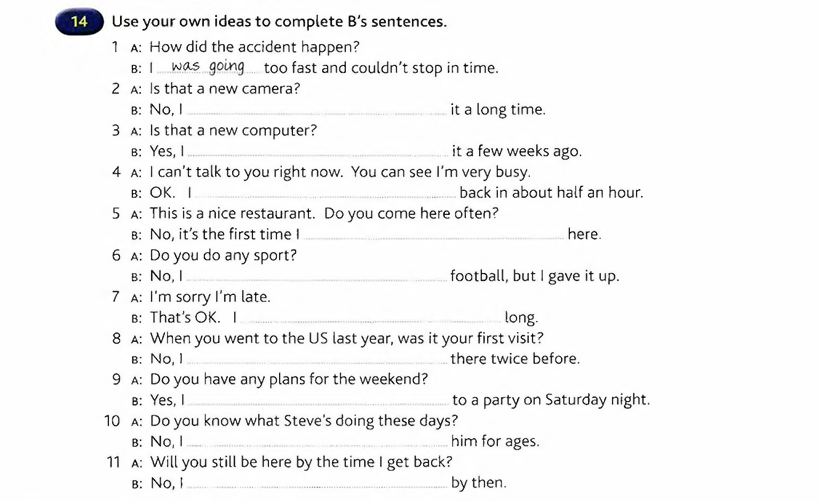
Today is the last class of our current March class period. The start time for our class will be 10:00am. We will begin class with a casual conversation. Our reading today is an essay about starting a band. Please try to read as much as possible. Underline any words or sentences that are unfamiliar. Our listening is about stolen art. We will finish with our grammar sentences.
Click HERE for the reading
Selling a stolen Van Gogh is a challenge. Well, yeah. I guess so. You can't exactly auction it off or offer it on eBay, even on the black market. A painting that famous is considered radioactive. So what do you do when you just want it gone but you can't turn it in? That's where Arthur Brand comes in - a Dutch art detective. Reporter Rebecca Rosman has the story.
(SOUNDBITE OF FOOTSTEPS)
REBECCA ROSMAN: Hello.
ARTHUR BRAND: It's freezing, isn't it?
ROSMAN: On a frosty day in February, Arthur Brand welcomes me into his modest Amsterdam apartment. He invites me to sit on his turquoise couch, a piece of ordinary furniture that's briefly held some extraordinary things. There's the stolen Van Gogh that showed up on his doorstep in a blue Ikea bag, the Salvador Dali painting he says he recovered. And once...
BRAND: There was a Picasso here on the wall.
ROSMAN: For the last 20 years, Brand has helped recover stolen art, earning him the nickname the Indiana Jones of the art world. Although Brand says he's closer to Inspector Clouseau from "The Pink Panther."
BRAND: Do you know Peter Sellers' Inspector Clouseau?
ROSMAN: Of course.
BRAND: Well, I'm like that, you know. I always follow the wrong leads.
ROSMAN: He's self-deprecating, but Brand says he's recovered more than a hundred and fifty stolen paintings and artifacts, often making international headlines. At any given time, he says he's working on roughly a dozen cases. But he's quick to point out he's not on anyone's payroll.
BRAND: I'm not hired by an insurance company. The police, of course, does not pay me. So I do that on my own cost.
ROSMAN: Brand says he makes his money consulting art galleries and helping Jewish families trace art looted during World War II. But most of his energy goes to work he does on his own dime - acting as a go-between for police and the people who might know where stolen art is hiding. Brand says the whole job runs on trust and on the fact that trust is in short supply.
BRAND: The police doesn't trust the informants. The informants don't trust the police. So I want to form a bridge between them to see what can be done. And in most cases, it's possible.
ROSMAN: And the Dutch police say Brand's motive is part of why it works. Richard Bronswijk heads the Dutch police art crime unit.
RICHARD BRONSWIJK: I've worked before with private detectives who are doing this for money, and then it's always dangerous.
ROSMAN: But Brand, he says, has always been motivated by something else.
BRAND: Everybody's in it for the money, and I'm not. They cannot buy me. I have another drive, and that makes me so dangerous.
ROSMAN: That other drive, he says, is the thrill of the work itself. Take the Van Gogh case he still talks about, known as the Spring Garden. The piece was stolen from a Dutch museum in 2020. Police caught the thief a year later, but the painting was still missing. Then Brand says he got a tip from an informant. A gang was sitting on it as leverage until the attention made it too risky to keep.
BRAND: They didn't know it would attract so much attention, so everybody wants to get rid of it.
ROSMAN: Brand said the informant told him he could return it, but only if Brand guaranteed confidentiality, and he needed proof he could trust Brand. So Brand called in an ace.
OCTAVE DURHAM: My name is Octave Durham. I'm known for robbing the Van Gogh Museum in 2002. I stole two paintings.
ROSMAN: Octave Durham, an art thief-turned-informant, who today regularly works with Brand. Brand says Durham still has credibility in the criminal underworld. So he asked Durham to send the informant a text on his behalf.
DURHAM: And I said, I don't know who you are. The only thing I can say, I guarantee you don't get into trouble if you talk to him.
ROSMAN: It worked. Brand says one afternoon, the informant showed up on his doorstep with a blue Ikea bag. Opening the bag, Brand says he felt like a kid on Christmas morning.
BRAND: I unpacked the Van Gogh, and it's one of the most beautiful moments of my life.
ROSMAN: Brand says moments like this explain why he got into this business. He gets to feel like Robert Langdon, the protagonist from Dan Brown's novels. Earlier this year, it all came full circle.
BRAND: Look at - I will show you. Take a picture.
ROSMAN: Brand takes me to his bookshelf and shows me a framed photo of him standing next to the thriller author who was recently in Amsterdam to promote a new book. Next to the photo is a framed note.
(SOUNDBITE OF PAPER UNFOLDING)
BRAND: (Reading) To Arthur, the real-world Robert Langdon, with gratitude for all you do, Dan Brown.
ROSMAN: Brand says the note is priceless because, after all, in his line of work, trust is the one thing you can't fake.
Rebecca Rosman, NPR News, Amsterdam.